Aug 2, 2026
Glued vs Screw-Mounted Magnets in Hardware Design

The magnets were falling out
Ten months ago I wrote a post about how the magnetic plate system works. In it I listed three problems I had solved: alignment, magnet strength, and connector reliability. I was fairly pleased with that post.
One of those three was wrong. Not wrong in the sense that I picked bad numbers, wrong in the sense that I had answered a question nobody was going to fail on and skipped the one they would.
What actually happened
The magnets in the swappable plates were glued in. Small neodymium magnets dropped into pockets and bonded in place with adhesive. It is a completely normal way to do this. It adds no thickness, no extra parts, no assembly steps, and it works immediately.
It also stopped working after a few weeks of real use. Magnets started coming loose. Not many, not all at once, but enough that I could reproduce it just by using the pad the way anyone would.
The reason is boring once you see it, which is how these things usually go. When you pull a plate off, you are pulling directly against the magnetic attraction holding it down. That load goes straight into the bond line as tension. Adhesive is good at resisting sliding and bad at resisting being peeled apart, and swapping a plate is closer to the second thing than the first. Every single swap is a small attempt to pull the magnet out of its pocket. Do that a few hundred times and eventually one of them wins.
So the failure mode was not weak magnets. The magnets were fine. The magnets were doing exactly what I had tuned them to do, and that was the problem, because the thing holding them in place was weaker than the thing pulling them out.
The fixes that didn't work
I tried the obvious ones first, in the order everyone tries them.
A stronger adhesive helps a little and delays the problem rather than removing it. The load case is still wrong, you are just asking a better glue to do the same unsuitable job.
A tighter press fit sounds better but runs into tolerances. Magnets are sintered and their dimensional tolerance is not great, so a pocket tight enough to grip the small ones is tight enough to crack the plate around the large ones.
Recessing the magnet deeper and capping it over is a real solution, but it costs thickness, and thickness is the one thing a pad like this cannot spare.

What I ended up with
Custom screw-attachable magnets. Rather than bonding the magnet to the plate, the magnet is mechanically captured and held by a screw, so the pull-out load is carried by threads and by the structure of the plate instead of by a bond line.
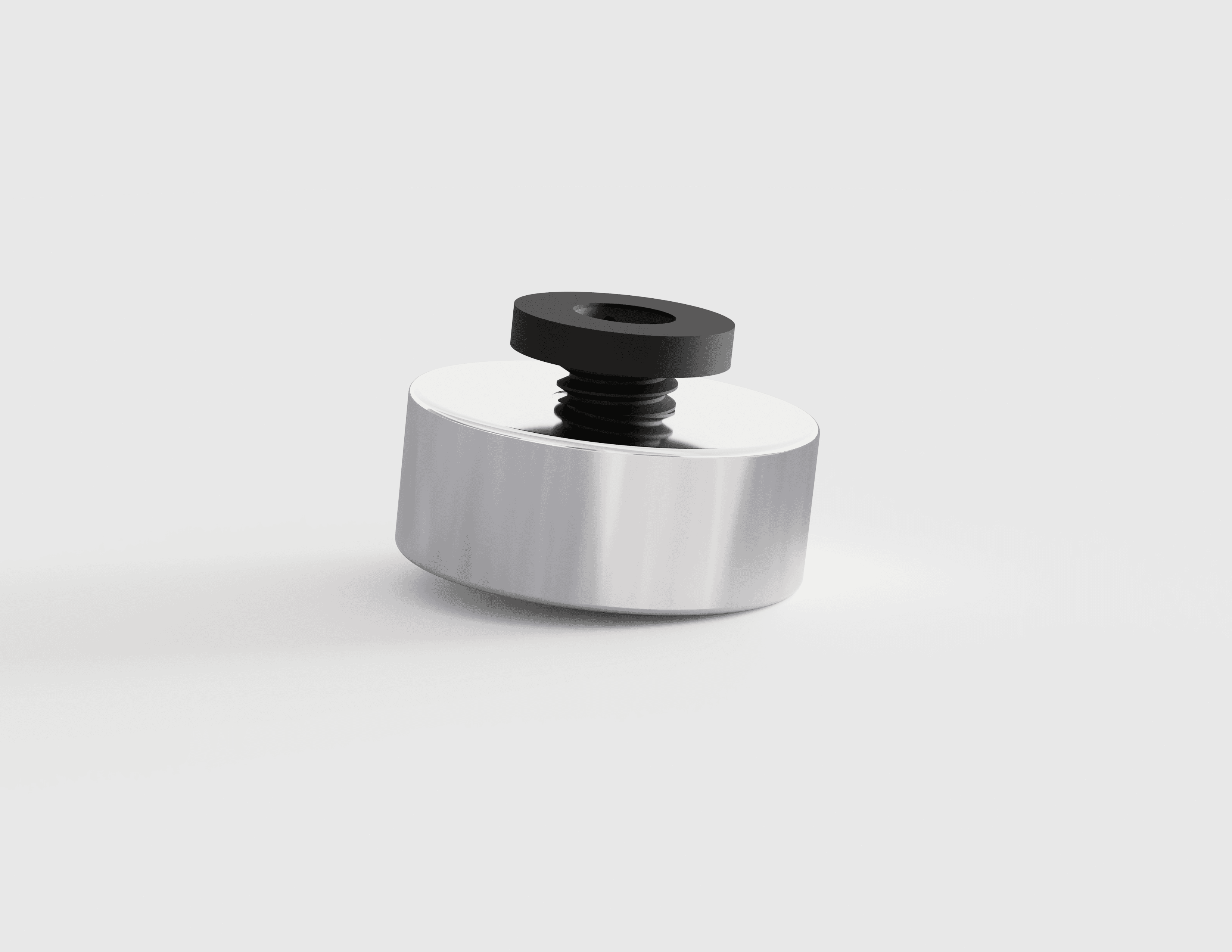
This is not a free fix. It meant a custom part with a minimum order quantity and a lead time, extra components in every plate, and an extra step in assembly. It also meant the plates themselves had to change to give those screws somewhere to land, which turned out to be the start of a much longer story.
But a swappable system where the swapping mechanism wears out is not a product, it is a demo. That was worth paying for.
What I take from it
The uncomfortable part is not that a prototype failed. Prototypes are supposed to fail, that is the entire point of building them.
The uncomfortable part is that I wrote a confident public post about choosing exactly the right magnet strength, and never once asked what was holding the magnet in. I optimised the interesting variable and assumed the boring one. That is a mistake I would like to think I will not make again, and almost certainly will.
share